
2026-08-31 · Daniel Wilson
Drying Out Homes After Summer Rains in Scottsdale
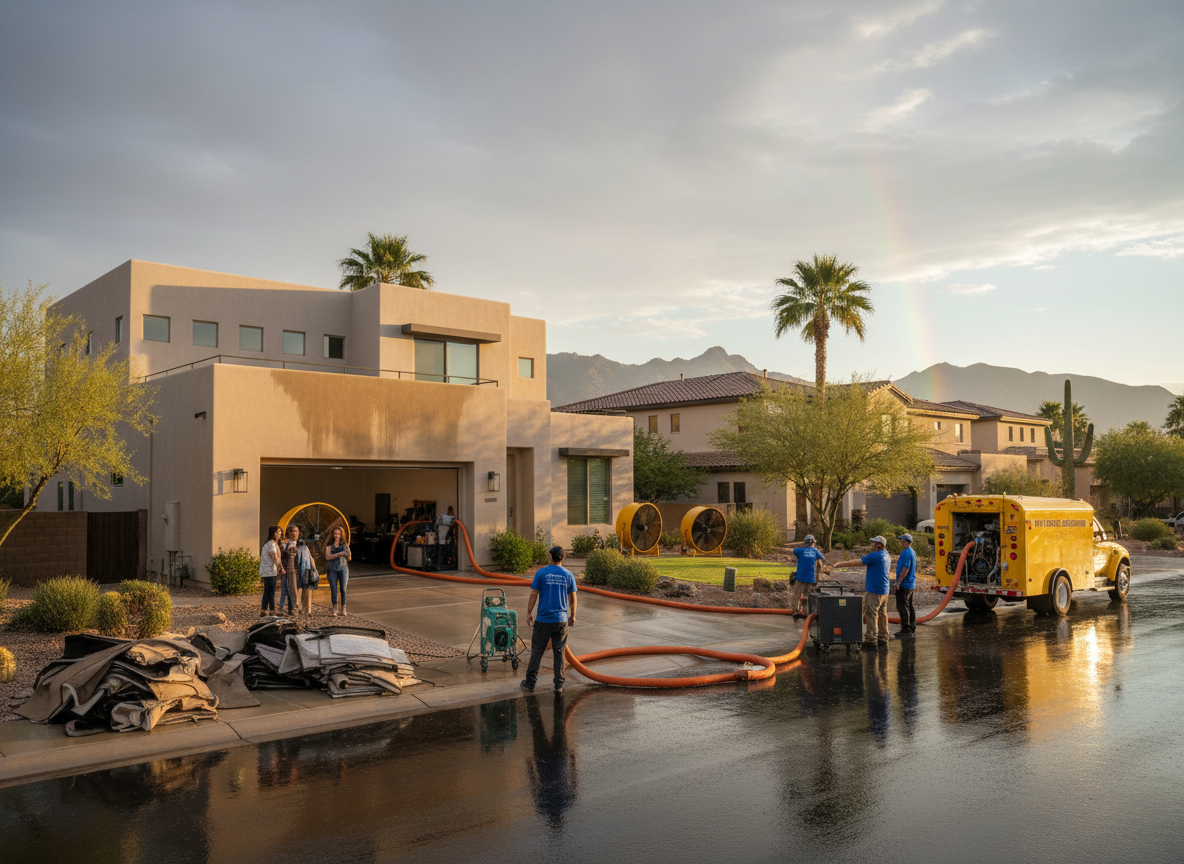
Drying out homes after summer rains in Scottsdale usually requires 4 to 8 days of active dehumidification and airflow when monsoon moisture penetrates stucco walls, tile floors, and attic insulation across Maricopa County properties.
Monsoon Moisture Patterns in Scottsdale Housing Stock
Scottsdale receives most of its annual rainfall during July and August monsoons that drop 1 to 3 inches in a single afternoon. Older homes built before 1990 in Old Town Scottsdale often have single-layer stucco over wood framing that absorbs water at the baseboards, while newer builds in McCormick Ranch and Gainey Ranch use thicker foam-core stucco that traps moisture behind the finish. The hot desert climate accelerates surface drying yet leaves hidden pockets under tile and in wall cavities because relative humidity spikes above 60 percent during storms. Properties near Camelback Mountain and the Scottsdale Waterfront also face runoff from surrounding slopes that channels water toward foundations.
First 24 Hours: Extraction and Containment
Standing water must be removed before it migrates into subfloors or HVAC returns. Technicians deploy truck-mounted extraction units on concrete slabs common in South Scottsdale and Paradise Valley Village, pulling 50 to 100 gallons per 1,000 square feet from saturated carpet pads and base layers. Air movers are positioned to create negative pressure in affected rooms while plastic barriers isolate hallways to prevent spore spread. In homes near Scottsdale Fashion Square or the Civic Center, quick containment also protects shared walls in townhomes. This step prevents the 24-hour mark from becoming the point where drywall begins to delaminate.
Structural Drying and Dehumidification Process
Once bulk water is gone, industrial dehumidifiers rated at 70 to 150 pints per day pull remaining moisture from drywall, insulation, and wood framing. In Troon North and Desert Mountain properties with vaulted ceilings, technicians place drying mats on tile and direct high-velocity fans into wall cavities through small access holes. Daily moisture readings track progress until drywall returns to 12 to 15 percent moisture content. The arid climate helps once humidity drops, yet monsoon follow-up showers can reset progress if windows remain sealed. Structural drying and dehumidification equipment runs continuously until readings stabilize.
Preventing Mold After Hidden Saturation
Mold colonies can appear within 48 to 72 hours when cellulose materials stay above 20 percent moisture. In Gainey Ranch and North Scottsdale homes, inspectors check behind baseboards and under vanities where monsoon water often pools unnoticed. Removing and replacing affected insulation or treating framing with antimicrobial solutions stops growth before it reaches HVAC systems. Residents in Paradise Valley and Tempe who delay inspection frequently discover colonies weeks later when musty odors appear in closets. Flood damage cleanup protocols include post-drying verification to confirm no residual moisture remains in wall cavities.
When to Seek Professional Assessment
Homeowners can handle surface mopping, yet hidden saturation in slab homes or multi-story properties near drainage channels requires meters and thermal imaging. How to remove standing water safely after a desert flood outlines initial steps, but persistent readings above 18 percent after three days indicate the need for equipment beyond consumer rentals. Properties in McDowell Mountain Ranch and Ancala with expansive soil also risk foundation movement if drying is uneven. Scottsdale Restoration Solutions operates from 7111 E Thomas Rd with hours Mon–Fri 8am–6pm and Sat 9am–2pm for rapid response after storms.